

A Common Virtue
The uncommon valor of the Marines on Iwo Jima

Originally published February 23, 2025. Updated February 2026.
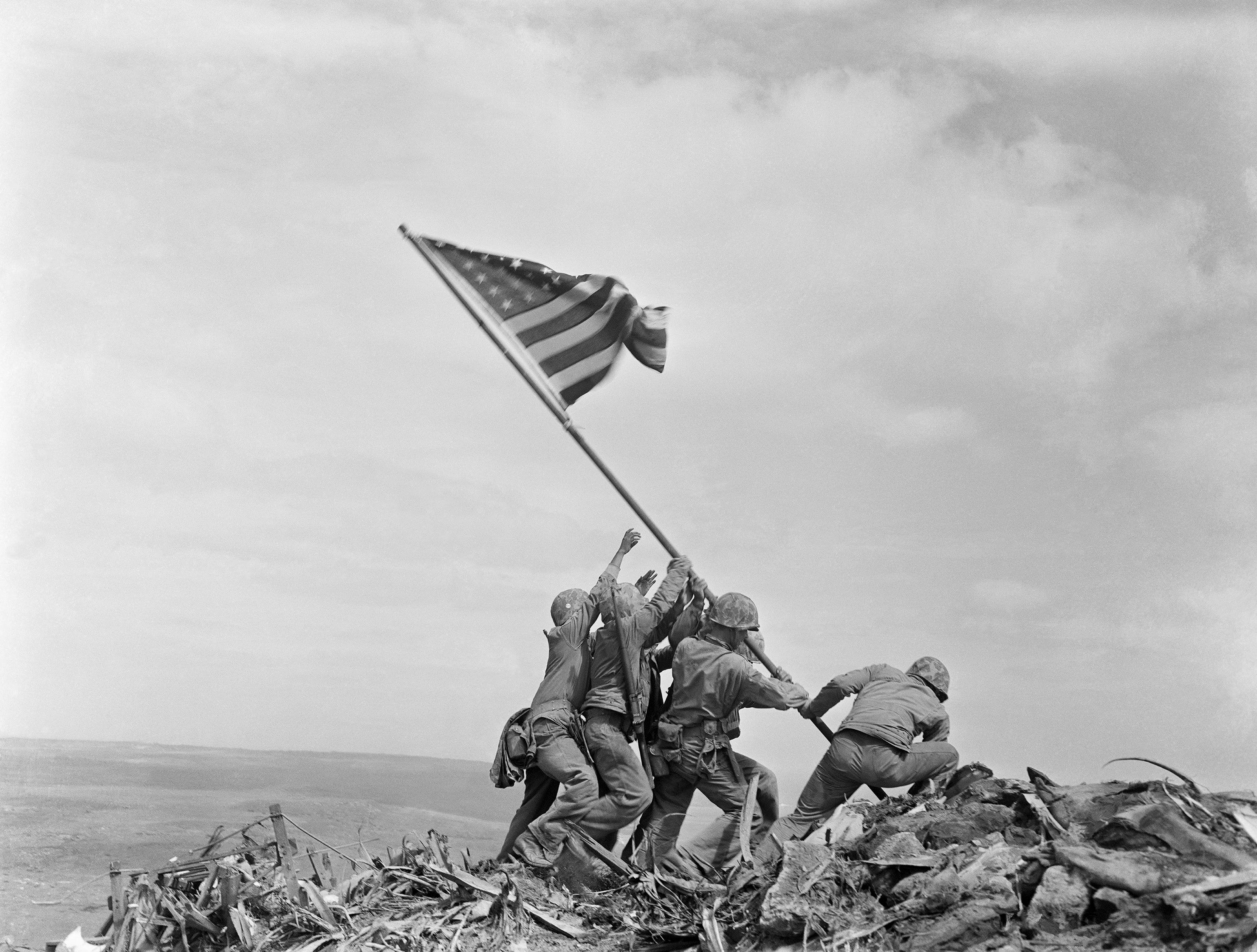
Eighty-one years ago today was D-day+6 on the Japanese island of Iwo Jima, and this Monday marked the anniversary of the day that six Marines ascended Mount Suribachi, on the southern tip of the tiny volcanic landmass, and raised the stars and stripes atop its summit.
The moment was immortalized by Associated Press photographer Joe Rosenthal, who won the Pulitzer Prize for his timely snapshot.
If you’ve ever found yourself inclined to believe that the picture was the product of a casual photo op, think again.
The Marines in the iconic photograph were all assigned to Easy Company, 2nd Battalion, 28th Marine Regiment (2/28) of the 5th Marine Division. In the initial phase of the operation, the 28th Regiment was specifically assigned to isolate and capture Mount Suribachi, the highest point on the Island.
The genesis of Operation Detachment, the amphibious assault on Iwo Jima, took place in San Francisco in September 1944 during a strategic planning conference of Pacific theater commanders and representatives of the Joint Chiefs of Staff. At the conference, it was decided that the first priority would be to secure Luzon, the largest of the Philippine Islands.
Following the Luzon campaign, the next objective would be the seizure of the Bonins-Volacano island chain, with a particular emphasis on the island of Iwo Jima. That idea had been proposed by the Army Air Forces, who believed that a Japanese radar site on the island was providing early warning of US air raids to the Japanese Home Island air defenses and that the island’s airfields served as a base for Japanese fighters that posed a threat to American B-29 bombers.
While this intelligence forced the B-29s to fly longer, more circuitous routes to avoid the island, it turned out that the assumption about Japanese early warning capabilities was incorrect and that the airfields’ strategic utility had already been negated by events elsewhere in the Pacific theater.
Overture
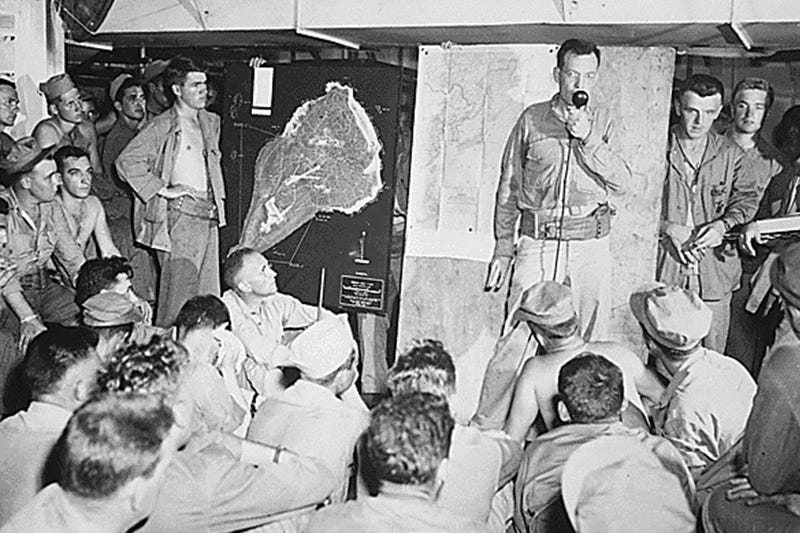
For Operation Detachment, Admiral Raymond A. Spruance’s Fifth Fleet was charged with providing amphibious lift, naval gunfire, air cover, and logistical support to Task Force 56 (TF-56), under the command of LtGen Holland M. Smith.
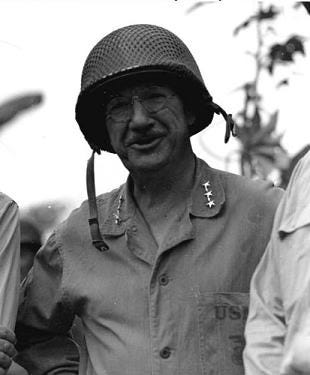
The bulk of TF-56’s ground combat element was the roughly 70,000 Marines of MGen Harry Schmidt’s V Corps, which included the 4th and 5th Marine Divisions, with the 3rd Division in reserve, afloat. V Corps was also supported by the Army’s 147th Infantry Regiment and approximately 40,000 Navy personnel.
D-Day for Operation Detachment would be 19 February 1945.
Iwo Jima was defended by 21,000 Japanese troops under the command of General Tadamichi Kuribayashi, who, upon arriving on the island in the summer of 1944, immediately set to the task of constructing an extensive defensive network, usually directing that the work be done at night to avoid aerial surveillance.
Keep reading with a 7-day free trial
Subscribe to Danger Close with Brian O'Leary to keep reading this post and get 7 days of free access to the full post archives.